


BJJ Gi Weight Guide: 350 vs 450 vs 550 GSM Explained
BJJ gi weight guide is measured in GSM, the grams per square metre of the jacket fabric, and it decides comfort, durability, and weigh-in margin. A 350 GSM gi is light, fast-drying, and favoured for competition and hot climates. A 450 GSM gi is the all-round standard for daily training. A 550 GSM gi is heavy, hard-wearing, and suited to cold climates and grip-heavy training. Most practitioners are best served by a 450 GSM Pearl Weave, with 350 GSM as the second gi for competition cuts.
What Does GSM Mean on a BJJ Gi?
GSM on a BJJ gi means grams per square metre, the standard measure of how dense and heavy the jacket fabric is. A higher GSM number means a thicker, heavier, more durable weave, while a lower number means a lighter, cooler, faster-drying jacket. GSM refers to the jacket only, because the pants are measured separately in cotton ounces or their own weave. The figure matters because it is the single spec that predicts how a gi feels on the mat, how long it lasts, and how much it adds at the competition scale. Browse the full BJJ gi options to compare weights side by side.
GSM is not a quality score on its own, which is the point most buyers miss. A 550 GSM gi is not better than a 350 GSM gi, it is heavier and suited to a different job. A competitor cutting to make weight wants the lightest legal jacket, while a hobbyist training in a cold gym wants the warmth and durability of a heavier weave. The right GSM is the one that matches your training environment and goals, not the highest number on the rack.
Why Does Gi Weight Affect Your Training and Competition?
Gi weight affects training and competition through three levers: heat, durability, and weigh-in margin. A heavier jacket traps more body heat, which is punishing in a hot, humid gym and welcome in a cold one. A heavier weave also resists grip wear and lasts more seasons, which lowers the cost per year of training. At competition, the gi is weighed with the athlete, so a heavier gi eats into the margin and can push a borderline competitor into the next weight class. Each lever pulls in a different direction, which is why no single weight wins for everyone.
Training frequency changes the maths on durability. An athlete training five or six times a week wears out a light 350 GSM jacket faster than someone training twice a week, so the heavier gi can be cheaper per year despite the higher sticker price. Climate is the second multiplier. A 550 GSM gi that feels great in a Canadian winter is unwearable in a Dubai summer. Match the weight to how often and where you train before you look at colour or brand.
What Is the Best Gi Weight for Beginners?
The best gi weight for beginners is 350 to 450 GSM, light enough to stay comfortable through long classes while learning. A beginner sweats more, gases out faster, and benefits from a cooler, lighter jacket that does not add fatigue. A 350 GSM single or pearl weave keeps a new student comfortable in a warm gym, while 450 GSM suits a cooler room or a student who wants one durable gi to last the white-to-blue belt journey. Avoid a 550 GSM gi as a first purchase, because the extra weight and stiffness work against a beginner still building conditioning.
One durable mid-weight gi beats two cheap light ones for most beginners. A 450 GSM Pearl Weave handles three to four sessions a week, survives frequent washing, and breaks in to the body over the first month. Pair the jacket with correctly sized pants and confirm the fit against the BJJ gi size chart before ordering, because a gi that fits wrong is worse than one a few GSM off the ideal.
350 GSM: The Competition and Hot-Climate Lightweight
A 350 GSM gi is the lightweight choice built for competition and hot climates, where every gram and every degree counts. The light jacket dries faster between rounds, adds the least weight at the scale, and keeps the athlete cooler under tournament lights. Competitors cutting to make a weight class reach for 350 GSM precisely because it leaves the most margin on the official scale. The trade-off is durability, since a light weave wears at the grips faster than a heavy one under daily training.
For year-round training in hot, humid gyms, a 350 GSM jacket is often the most comfortable daily option despite the durability cost. Athletes in tropical and desert climates frequently train in light gis all year and accept replacing them more often. The lightweight gis in the BJJ gi jacket range suit both the competition cut and the hot-climate daily roll.
Is 450 GSM the Best All-Round BJJ Gi Weight?
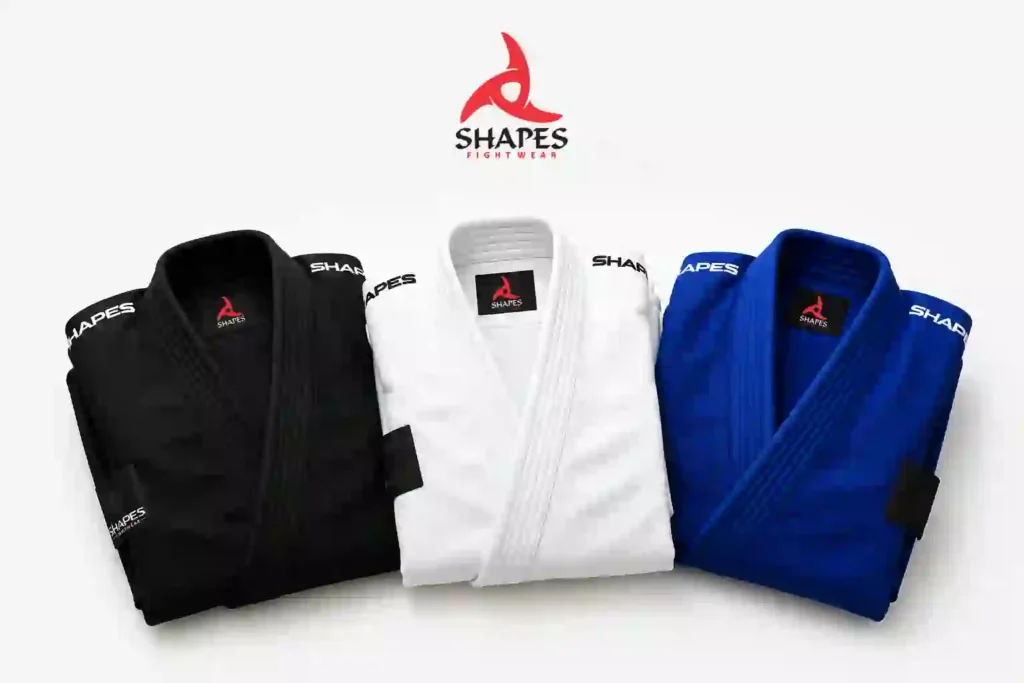
Yes, 450 GSM is the best all-round BJJ gi weight for most practitioners, balancing durability, comfort, and weigh-in margin. A 450 GSM Pearl Weave is heavy enough to survive years of grip-heavy training yet light enough to stay comfortable through a normal class. It is the default weight across the competitive circuit and the safe recommendation when an athlete wants one gi to do everything. The weight sits in the sweet spot where the jacket lasts without becoming a sweat trap.
The all-round label holds because 450 GSM rarely fails any single test badly. It is not the absolute lightest for a weight cut, nor the most durable for daily double sessions, but it is strong on both. For an athlete who trains three to five times a week in a temperate gym and competes occasionally, 450 GSM is the lowest-risk purchase. Most of the Shapes BJJ gi range centres on this weight for exactly that reason.
When Should You Choose a 550 GSM Heavy Gi?
Choose a 550 GSM heavy gi when you train often in a cold climate or want maximum durability and grip resistance. The heavy weave shrugs off years of grip fighting, resists tearing at the lapel and sleeves, and adds warmth that suits a cold gym or an early-morning winter session. Grapplers who train double sessions daily often prefer the heavy gi because it outlasts lighter weaves under that volume. The cost is heat and weigh-in margin, so a 550 GSM gi is rarely the competition choice for an athlete watching the scale.
A heavy gi also changes the grip game slightly, since the thicker lapel and collar are harder for an opponent to grip and control. Some practitioners value that on the mat, while others find the extra stiffness slows their game. The reinforced construction details that pair with heavy weaves are covered on the Shapes gi features page for buyers comparing build quality across weights.
How Does Gi Weight Affect IBJJF Competition Weigh-In?
Gi weight affects IBJJF weigh-in directly, because the athlete is weighed wearing the full gi, so a heavier jacket counts against the weight limit. The International Brazilian Jiu-Jitsu Federation weighs each competitor in their gi at the bullpen, which means a 550 GSM gi can add enough to push a borderline athlete over the class limit. Competitors managing a tight cut choose the lightest legal gi, usually 350 GSM, to preserve margin at the scale. The official rules and weigh-in procedure are published by the IBJJF and should be checked before any sanctioned event.
| GSM | Best Use Case | Climate Fit | Weigh-In Margin |
| 350 GSM | Competition, hot-gym daily training | Hot and humid | Maximum margin |
| 400 GSM | Light training, beginner first gi | Warm to temperate | High margin |
| 450 GSM | All-round daily training, occasional comp | Temperate | Moderate margin |
| 550 GSM | Heavy daily training, durability focus | Cold | Low margin |
The weigh-in row is the one competitors most often overlook until the scale catches them. An athlete cutting to a class should weigh themselves in the exact gi they plan to compete in, not in shorts, because the gi can swing the result by over a kilogram between a light and a heavy weave.
How Does Washing and Shrinkage Change Gi Weight?
Washing changes a gi by shrinking the cotton, which tightens the fit and slightly raises the effective density, especially on the first few hot washes. A new cotton gi can shrink 3 to 5 percent in length on its first hot cycle, which is why buyers often size up or pre-shrink deliberately. Hot water and tumble drying accelerate shrinkage, while cold washing and hang drying preserve the original cut. Colourfastness and dimensional stability under repeated washing are measured by standardised textile tests such as those published by the AATCC, which is why quality gis hold their size better across a season of washing.
The practical takeaway is to control shrinkage rather than fear it. Wash a new gi in cold water, hang dry it, and only use controlled heat if you deliberately want a tighter fit. A gi cared for this way keeps the weight and fit you bought, season after season. The full wash and shrink routine sits in the BJJ gi care guide for athletes protecting a competition gi.
Why Buy Your BJJ Gi from Shapes Fightwear
Shapes Fightwear manufactures premium custom BJJ gis in Sialkot, Pakistan—the global hub for combat sports apparel—offering the complete range of 350 to 550 GSM pearl weave fabrics. Every gi is built to the same high construction standard with reinforced stress points, durable stitching, and IBJJF-aligned dimensions, allowing athletes to choose the ideal weight based on their training style and climate rather than differences in quality. Whether you need a lightweight competition gi or a heavyweight training gi, every option delivers the same premium craftsmanship. Explore the full Shapes BJJ gi range to choose your weight.
Unlike many manufacturers, Shapes Fightwear also accepts single-piece custom BJJ gi orders, giving individuals the freedom to design a fully personalized gi without meeting a minimum order quantity. Customers can customize colors, sublimated linings, embroidery, woven patches, labels, contrast stitching, and other branding details to create a truly unique gi. We also manufacture larger and special-size BJJ gis, with extended sizing and made-to-measure options available for athletes who need a more precise fit.
For academies, clubs, and teams, consistency across an entire roster is just as important as fabric weight. Shapes Fightwear's custom academy BJJ gi program ensures every athlete receives the same weave, cut, and construction quality while allowing complete customization with team logos, academy branding, sponsor artwork, and personalized names. Before placing a bulk order, you can order a single fully customized sample gi to evaluate the fit, design, fabric weight, and overall quality. Once approved, production can be scaled for your entire team with complete consistency across every size—including larger and special sizes—ensuring every athlete receives a professional, uniform appearance.
Frequently Asked Questions
What is the best BJJ gi weight for beginners?
The best BJJ gi weight for beginners is 350 to 450 GSM, light enough to stay comfortable through long classes while building conditioning. A 350 GSM gi suits a hot gym, while 450 GSM gives a beginner one durable gi for the white-to-blue journey. Avoid a 550 GSM heavy gi as a first purchase, since the weight and stiffness work against a new student.
What does GSM mean on a gi?
GSM means grams per square metre, the measure of how dense and heavy the gi jacket fabric is. A higher GSM is thicker, heavier, and more durable; a lower GSM is lighter, cooler, and faster-drying. GSM describes the jacket only, as the pants are measured separately. It predicts how the gi feels, how long it lasts, and how much it adds at weigh-in.
Is a 350 GSM gi good for competition?
Yes, a 350 GSM gi is a strong competition choice because it is light, dries fast, and adds the least weight at the scale. Competitors cutting to a weight class choose 350 GSM to preserve weigh-in margin. The trade-off is durability, since the light weave wears faster under daily training than a heavier 450 or 550 GSM gi.
What is the best all-round BJJ gi weight?
The best all-round BJJ gi weight is 450 GSM, which balances durability, comfort, and weigh-in margin. A 450 GSM Pearl Weave survives years of grip-heavy training yet stays comfortable through a normal class. It is the default for athletes who train three to five times a week in a temperate gym and compete occasionally.
Does gi weight matter for IBJJF weigh-in?
Yes, gi weight matters for IBJJF weigh-in because the athlete is weighed wearing the full gi. A heavy 550 GSM gi can push a borderline competitor over the class limit, while a light 350 GSM gi preserves margin. Always weigh yourself in the exact gi you will compete in, since the difference between weaves can exceed a kilogram.
How heavy is a 550 GSM gi?
A 550 GSM gi is a heavyweight gi with a dense jacket weave built for durability and cold-climate training. The exact total weight depends on size, but the jacket fabric is among the heaviest available and resists grip wear over years of use. It is best for athletes who train often in cold gyms and prioritise longevity over weigh-in margin.
Will my gi shrink and change weight after washing?
Yes, a new cotton gi can shrink 3 to 5 percent in length on its first hot wash, which tightens the fit. Hot water and tumble drying accelerate shrinkage, while cold washing and hang drying preserve the original cut. Control shrinkage by washing cold and hang drying, or use controlled heat deliberately if you want a tighter fit.
Final Thoughts
BJJ gi weight in GSM is a match between fabric and your training, not a ladder where heavier means better. Reach for 350 GSM for competition cuts and hot gyms, 450 GSM as the all-round daily standard, and 550 GSM for cold-climate durability and grip resistance. Match the weight to your climate and training volume first, confirm the fit against the size chart, and the gi will serve you for years rather than seasons.
To pick the right weight for how and where you train, compare weaves and weights and shop our BJJ gis across the full 350 to 550 GSM range.
 Deutsch